
Research
- Erc4626
- Decentralized Finance
- Chainwall
- Blockchain
- Cyber Security Awareness
Can ERC-4626 Exploits Be Prevented?
On July 1, 2026, Edel Finance, an Ethereum-based Aave-fork lending market, suffered an oracle manipulation exploit that caused an estimated loss of $403,000 according to Defimon Alerts.
On July 1, 2026, Edel Finance, an Ethereum-based Aave-fork lending market, suffered an oracle manipulation exploit that caused an estimated loss of $403,000 according to Defimon Alerts.
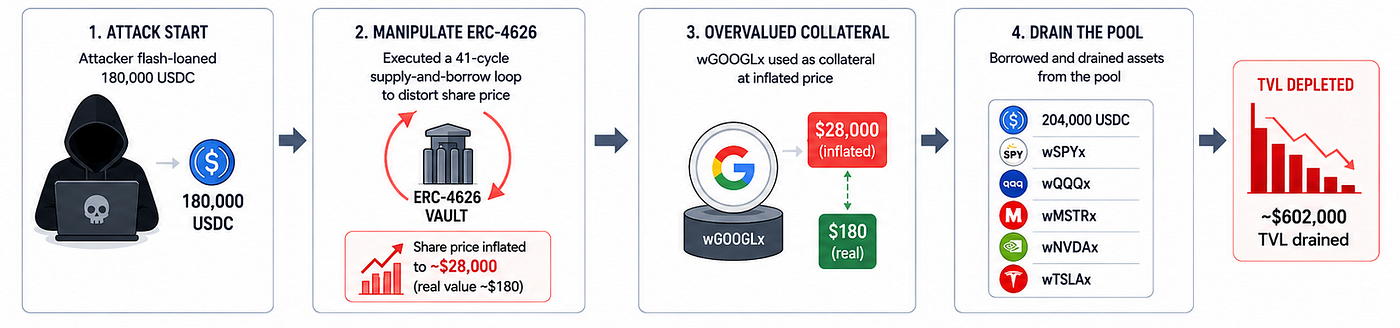
The attack targeted the protocol’s pricing mechanism for wGOOGLx, a wrapped xStock token accepted as collateral, whose oracle derived value from the ERC-4626 wrapper’s share-to-asset exchange rate. After flash-loaning 180,000 USDC, the attacker executed a 41-cycle supply-and-borrow loop that distorted the vault’s share ratio and inflated the reported wGOOGLx price to roughly $28,000, far above its approximate real value of "80. Using the overvalued collateral, the attacker borrowed and drained assets from the pool, including 204,000 USDC and wrapped stock tokens such as wSPYx, wQQQx, wMSTRx, wNVDAx, and wTSLAx, depleting most of the protocol’s roughly $602,000 in total value locked.
The admin control plane failure was not that ordinary users could deposit or borrow without a timelock. It was that the market was allowed to enter production with an unsafe configuration: wGOOGLx was accepted as collateral, its oracle trusted a manipulable spot ERC-4626 exchange rate, the market parameters gave that collateral real borrow power, and no capped oracle, TWAP, reference-price check, deviation guard, or immediately callable pause/cap-zero path stopped the listing before it was exploited.
How pre-execution policy could have reduced the risk
Chainwall is a registry-governed control plane where approved users, contracts, tokens, policies, scripts, and execution accounts define the valid operating world. DeFi protocols can put market listings, oracle rotations, supply-cap changes, pauses, and controller updates behind registry catalog changes, policy approval, timelock delay, and hash-bound execution.
For this incident, the strongest Chainwall setup would have been:
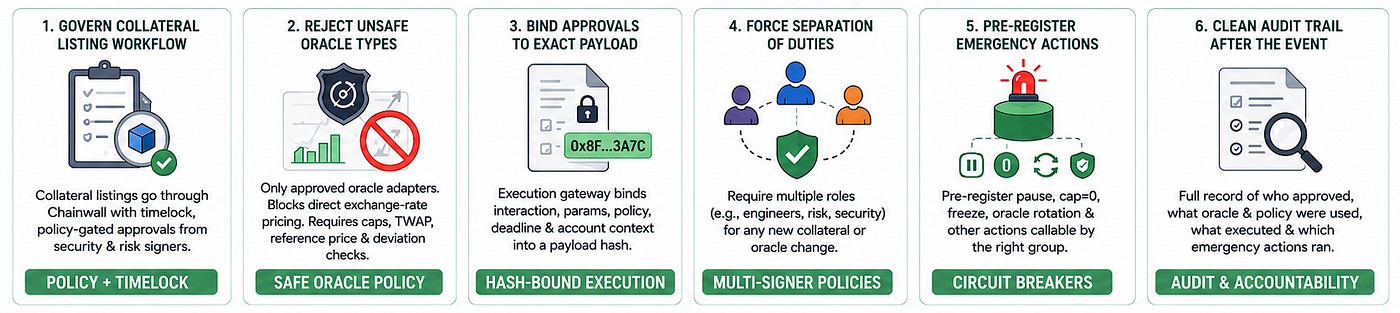
- Govern the collateral-listing workflow. Adding wGOOGLx as collateral should have been a Chainwall interaction, not a normal admin transaction. The interaction would register the wrapper, underlying token, oracle adapter, market contract, supply cap, borrow cap, LTV, liquidation threshold, and pause path in the registry. Because Chainwall can require timelocked, policy-gated registry writes for sensitive changes, a risky ERC-4626 collateral listing could require security and risk signers before activation.
- Reject unsafe oracle types by policy. The specific failure was using the wrapper’s spot
convertToAssets()exchange rate as the price source. ERC-4626 share prices are known to be manipulable when protocols integrate vault shares as collateral. Euler Finance notes that artificially raising share price can let an attacker borrow more value than allowed, and OpenZeppelin recommends controls such as CAPO-style rate caps and kill switches for ERC-4626 integrations. A Chainwall policy program could have required “approved oracle adapter only” for any ERC-4626 collateral. For example, it could block directconvertToAssets()pricing and require a capped oracle, TWAP, reference equity price feed, max exchange-rate growth bound, stale-feed checks, and max deviation checks against the underlying xStock’s real price. - Bind approvals to the exact market and oracle payload. Chainwall’s execution gateway binds the interaction id, arguments, policy id, deadline, value, and account context into a payload hash, then revalidates that hash at execution. Its workflow interpreter also resolves external targets through the registry rather than arbitrary raw addresses. That would matter if the unsafe listing came from a bad script, compromised frontend, stale ABI, copied address, or transaction builder that quietly swapped an oracle target. Signers would be approving a specific registered oracle and specific risk parameters, not a generic “list collateral” transaction.
- Force separation of duties. A minimal Chainwall policy for this market could require, for example, two protocol engineers, one risk signer, and one security signer for any new collateral or oracle change. Chainwall supports group-threshold policies and narrower capabilities such as token management, interaction execution, timelock governance, and pause operation, which lets the protocol separate “can propose a listing” from “can approve a listing” and “can emergency-pause a listing.”
- Pre-register emergency containment actions. Once wGOOGLx was observed at roughly $28,000 versus about "80 real value, the useful response would be to pause borrowing, set the collateral factor to zero, set the borrow cap to zero, freeze the market, or rotate the oracle. OWASP Smart Contract Security lists fail-safe behavior, circuit breakers, rate limiting, deviation monitoring, and alerts as oracle-manipulation mitigations. OpenZeppelin also calls out rapid-response kill switches for ERC-4626 volatility and manipulation. Chainwall could package those actions as pre-registered emergency interactions, callable only by the right emergency group or approved automation path, with execution still constrained to registered contracts and exact function calls.
- Give a clean audit trail after the event. Chainwall would preserve which users approved the collateral listing, which oracle adapter was registered, which policy was used, which payload executed, and which emergency actions were proposed or run. That helps distinguish a bad risk decision, a bad oracle design, an operator error, and a frontend or transaction-building failure. Chainwall’s operating flow explicitly includes configuring policies and catalogs, registering tokens and price feeds, executing through the gateway, and auditing the resulting registry, execution, and timelock records.
To sum up, once the lending contracts accept a manipulated ERC-4626 exchange rate as collateral value, the core exploit lives inside the market’s own pricing logic. Chainwall helps by making that dangerous configuration harder to approve, easier to review, slower to activate, constrained to known oracle adapters, and faster to contain through pre-registered pause paths.
Originally published on Medium.