
Research
- Erc4626
- Stablecoin Cryptocurrency
- Blockchain
- Cybersecurity
- Chainwall
The Attack Surface Has Moved to Vault Infrastructure
The $6 million Summer.fi exploit shows how vault accounting, stale asset values, strategy adapters, and operational controls define DeFi's attack surface.
Key finding
Vault infrastructure is becoming one of DeFi’s most important attack surfaces. Vaults depend on strategy adapters, accounting logic, caps, oracles, rebalancers, emergency controls, and signer workflows. The $6M Summer.fi exploit was a vault-accounting hack, flash-loan-funded manipulation of trusted reported balances. Vault security is now operational security, and it needs an onchain control plane.
The Summer.fi incident
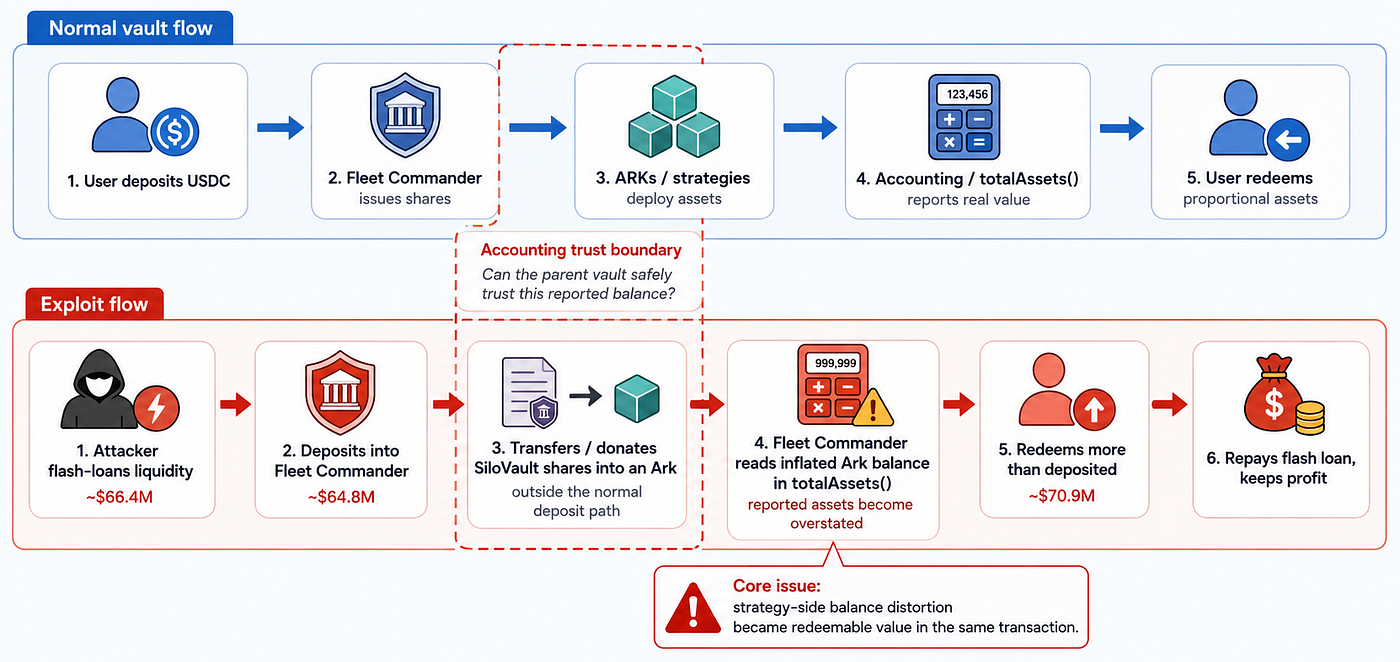
On July 6, 2026, Summer.fi paused Lazy Summer Protocol vaults after hit two Ethereum mainnet USDC vaults. Summer.fi’s post-mortem says the attacker manipulated the share price of LazyVault_LowerRisk_USDC and LazyVault_HigherRisk_USDC, extracting about $6.04 million of depositor value in one atomic transaction.
Lazy Summer vaults use a FleetCommander to manage deposits, withdrawals, allocation, and share issuance. ARKs are specialized strategy contracts that deploy assets into lending, staking, and other yield sources; each Fleet can route assets across multiple ARKs plus a Buffer ARK for withdrawals. The share price is derived from the total value reported by active Arks. The attacker’s lever was a Silo “Varlamore USDC Growth” position whose onchain valuation had not corrected after the earlier Stream Finance event. That position was donated into an Ark that had its deposit cap set to zero but was still counted in the vault’s NAV.
The exploit transaction then used flash-loaned stablecoin liquidity, funding as 1 million USDT and about 65.419 million USDC from Morpho flash loans, repaid inside the same transaction. The larger leg deposited about 64.8 million USDC into the LowerRisk vault at the honest share price, donated the stale-valued Silo shares into the off-boarding Ark, inflated totalAssets() and the share price, then redeemed at the inflated price. The redemption was paid from the buffer and liquid Arks, not from the manipulated Silo Ark. The donated asset only had to push up the vault’s accounting price. Once the share price was inflated, the attacker redeemed against real liquid USDC from other positions. Summer.fi says this was not a compromised-key or admin-privilege event; the affected protocol contracts behaved as written. The gap was an off-boarding window: an impaired Ark was capped, but still active in NAV.
The “pause” helped containment, not prevention
The response mattered, but it came after the atomic extraction. Summer.fi says Blockaid first raised the alarm, followed by CertiK, PeckShield, and Cyvers, with Summer.fi’s own tracing placing the loss at about $6.04 million. Protocol guardians then paused vaults across the Lazy Summer Protocol and set DAO-managed vault deposit caps to zero while the team and partners investigated. The Guardian Module had a narrow mandate. According to Summer.fi, it was an 8-signer multisig with a 6-of-8 threshold, able to pause vaults, set deposit caps to zero, and cancel risky governance proposals. It could not move user funds, onboard or offboard strategies, or tune parameters proactively. That scope is good safety design, but it also shows the limitation: emergency controls can stop copycats and freeze further exposure, but they cannot rewind a single atomic transaction that has already extracted value.
A gap in vault infrastructure
Last week we covered Edel Finance incident related to ERC-4626 vault infrastructure exploit. In that case, the dangerous trust point was an oracle accepting a manipulable ERC-4626 exchange rate as collateral value. In Summer.fi, the dangerous trust point was a vault accepting a stale-valued strategy position as NAV. Both incidents show the same pattern: once a protocol treats a vault share, adapter balance, or reported asset value as safe, attackers look for the cheapest way to move that number.
So the question is not only “can this Solidity function be exploited?” It is also “who is allowed to put this asset, adapter, oracle, Ark, cap, or withdrawal route into the valid operating set, and how does the system force review when that state becomes stale?”
How Chainwall might help secure vaults
Chainwall would not be “the patch” to vault accounting. A vault still needs donation-resistant accounting, impairment-aware NAV logic, and safe redemption design. But Chainwall can secure the operating layer around vaults: who can add a strategy, which contracts are approved, how offboarding works, which emergency actions exist, and whether signers approved the exact payload that executed. Teams can require those administrative actions to use explicit, policy-gated workflows. This does not change how a vault calculates NAV or make an adapter balance trustworthy; the vault contracts must still handle donations, impairments, and half-completed offboarding states correctly.
Instead of each strategy being a persistent contract that can hold assets, receive donations, report NAV, and sit half-offboarded, a strategy can be modeled as an approved interaction:
allocateToMorpho(market, amount)withdrawFromMorpho(market, amount)rebalance(route, maxSlippage, minAssetsOut)disableStrategy(strategyId)markStrategyImpaired(strategyId)sweepUnrecognizedToken(token, recipient)pauseVault()
Chainwall’s execution gateway binds the interaction id, arguments, policy id, deadline, value, and account context into a payload hash, then revalidates that the submitted calldata matches the approved hash and current policy state. Its workflow language resolves external targets through the registry rather than arbitrary raw addresses.
That matters for vault operations. With Chainwall, changes to strategy exposure can use explicit, approved workflows instead of broad admin calls. Only registered contracts can be called. Only registered interactions can run. Sensitive changes can be timelocked. Signers approve exact payloads, not vague admin actions. Purpose-built Chainwall smart accounts can also be bound to one execution gateway, one registry, and one workflow interpreter, so account operations stay inside the same policy boundary.
Lessons learned
The Summer.fi exploit was about the systems around vault shares: strategy adapters, offboarding states, valuation sources, NAV accounting, emergency powers, and governance workflows. “Cap set to zero” is not the same as “removed from economic trust.” A strategy is not safely offboarded while it can still move vault share price. A passive adapter is not harmless while direct token transfers can change reported NAV.
Chainwall gives vault teams a way to define approved people, contracts, policies, and workflows and to check them again at execution. For DeFi vault operations, that means exact-request approval, registry-resolved workflow calls, configurable waiting periods for sensitive changes, protected account paths, and onchain records. Vault accounting and NAV safety remain the responsibility of the vault and strategy contracts.
The future of vault security is not just better math. It is better operations enforced onchain.
Originally published on Medium.