
On November 16, 2026, about $6.45M left a Safe multisig on Ethereum in a single transaction, and none of the Safe's owners signed it.
Part of the money came out of a Morpho vault, so it is easy to read this as a Morpho hack, but the vault did what it was asked and the money left through a permissions module on the Safe.
What happened
It all happened in one Ethereum transaction: 0x6c7cce68b6373dd0e645e6667d46788f49da5a4afc286bc363a2bf34f0a8c9c5.
- A role member key, 0x065F395147FC72747c7f48f67f039d4235884148, calls the Zodiac Roles Modifier on the Safe with a MultiSend batch of five calls.
- The modifier checks each call against the role's policy and allows all of them.
- The Safe withdraws 4,387,188 USDC from the Gauntlet USDC Prime vault on Morpho with itself as receiver, then approves the Velora (ParaSwap) Augustus V6.2 router for USDC and for syrupUSDC.
- The Safe calls swapExactAmountIn on Augustus once per token, naming 0x2b02c38022FEE2f3c805055f49Cd8D24A90cB9E1 as the executor with a minimum output of 1 unit. Augustus moves 4,387,188 USDC and 1,717,919 syrupUSDC from the Safe to that executor, and the Safe gets 0 back.
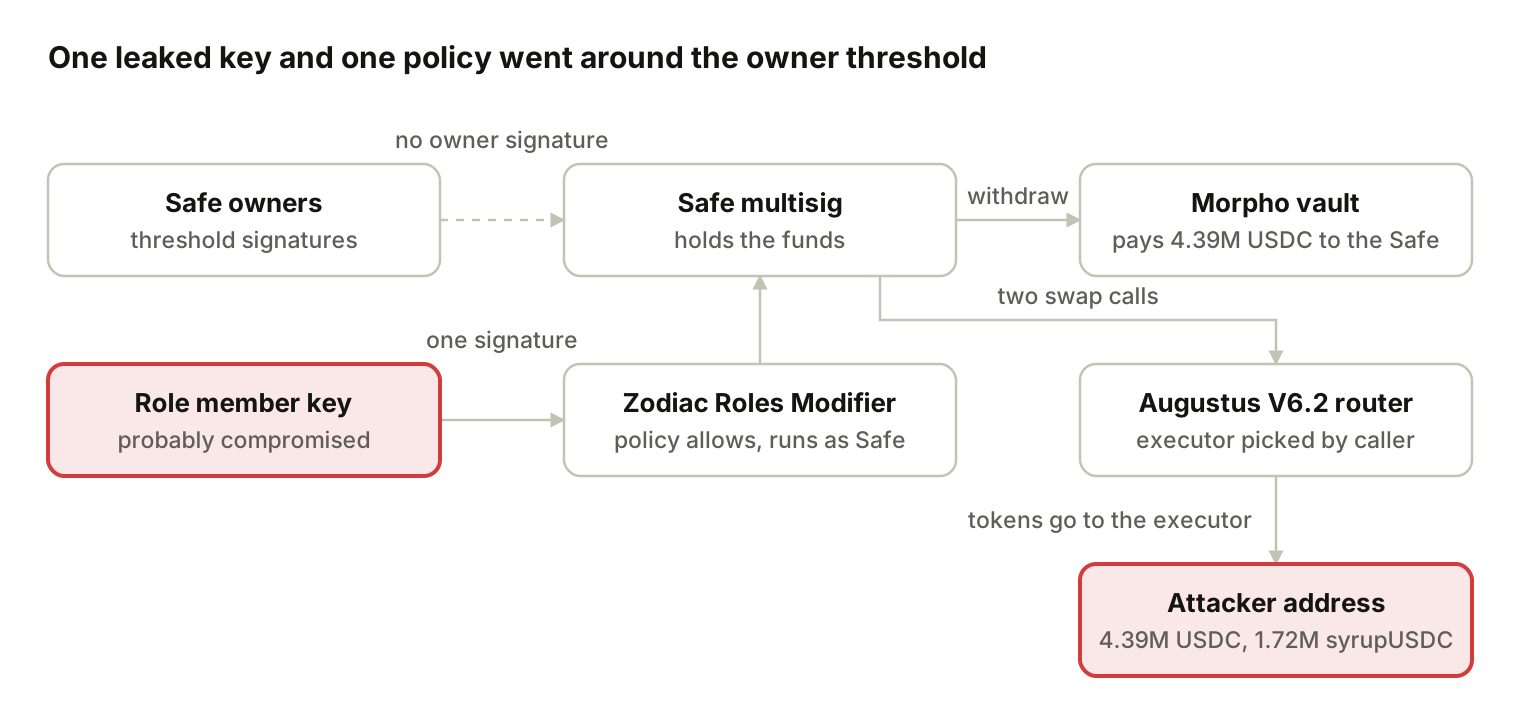
Path of the drain, from the leaked key to the attacker's address
syrupUSDC is Maple's yield-bearing USDC token. At about $1.19 per token the 1.72M syrupUSDC was worth about $2.04M, which puts the total near $6.43M. PeckShield, relaying on-chain investigator Specter, reported $6.45M.
The owner of the Safe has not been publicly identified.
Why this is not a Morpho hack
The Morpho connection is the 4.39M USDC, which was sitting in the Gauntlet USDC Prime vault on Morpho until the attacker made the Safe withdraw it. That withdrawal is an ordinary vault operation and the USDC went to the Safe itself, so nothing on the Morpho side misbehaved.
No bug has been reported in the Morpho, Gauntlet or Maple contracts.
How one key got to move the money
The Safe had a Zodiac Roles Modifier attached. It's a module whose owner attaches a policy to a role and then assigns addresses to that role. An address with a role can make the Safe do whatever the policy covers, and the Safe's owners don't sign. Teams set this up so a bot or an ops person can run routine treasury moves without collecting owner signatures every time.
The Safe's signature threshold doesn't apply to actions the policy covers, so for those actions a single key is enough.
Zodiac looked at the transaction and said its contracts were fine. In their words, the key sent a transaction that "a custom policy allowed but likely never intended."
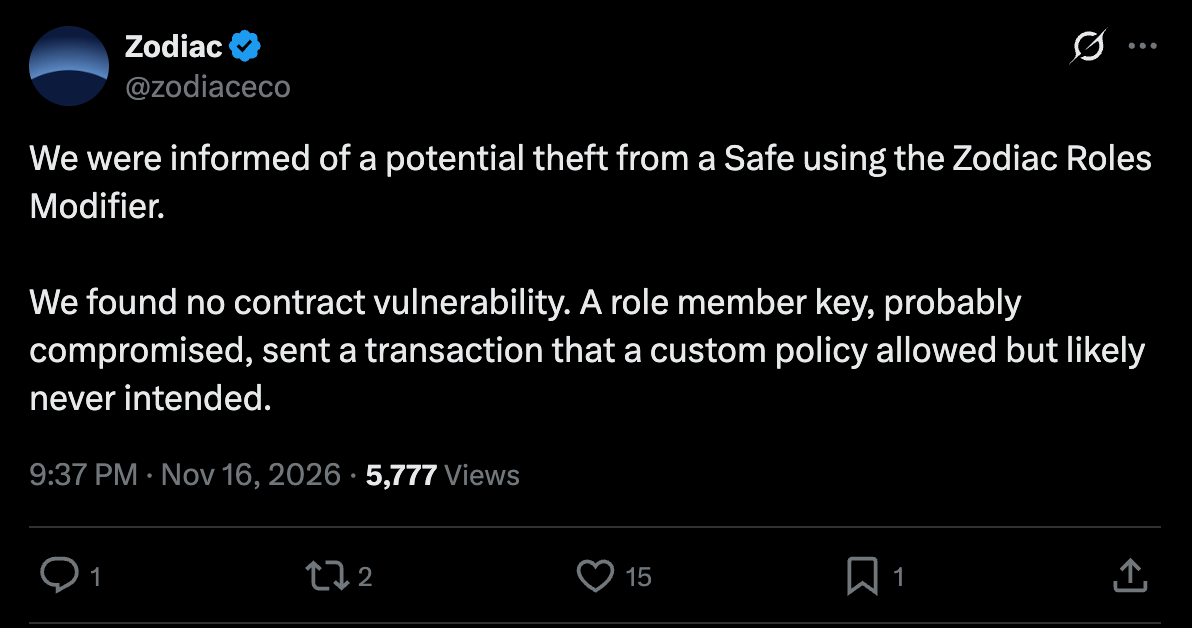
Co-founder Johannes Moormann told Cointelegraph the key belonged to a long-standing role member and was most likely compromised. Zodiac also says it never had access to the wallet's keys and didn't write its permissions. Safe confirmed that no owner signed and that the module was installed outside Safe{Wallet}.
Nobody has said how the key leaked, but the policy can be read from the module's logs, which record every scope change.
This Safe runs Roles v1, and for Augustus's swapExactAmountIn, the role carried two conditions: the beneficiary had to be the Safe, and the destination token had to be on an allowlist of 71 addresses. The function was scoped this way on Jan 14, 2025, and no other field of the call was ever restricted. The token list started at 36 addresses and reached 71 on Dec 4, 2025.
One of the open fields was the executor, which is the address Augustus hands the source tokens to, as the token transfers in this transaction show. The attacker put their own address there with a minimum output of 1 unit, so the tokens went to the attacker and the swap returned nothing to the Safe, while both policy conditions still passed.
The key that sent the transaction was given the role on June 26, 2024, the day the module was set up. The module's configuration was last changed on March 30, 2026, which means the attacker used the policy exactly as they found it.
Where the money went
Part of it has been traced into Monero purchases, and the trackers report different amounts:
| Tracker | What it saw |
|---|---|
| PeckShield | About $813,000 spent buying XMR on Hyperliquid |
| Specter | About $1.2M converted through Wagyu |
| Bitquery | Its initial count tracked about $1M of XMR1 purchases across five Hyperliquid accounts funded from the Safe |
These may be overlapping or separate conversions, and no one has accounted for the full $6.45M. Bitquery noted the route looks like one used after a separate Lighter drain but found no transfers linking the two.
Not the first Safe module incident this year
Coverage of this drain lists three earlier Safe module incidents in 2026.
| When | Incident | Loss | Cause |
|---|---|---|---|
| Nov 2026 | Safe with Zodiac Roles | About $6.45M | Leaked role key plus a policy that was too wide |
| Oct 2026 | FlashLoopAdapter, two Safes with Aave positions | About $305K | Weak access control in the module |
| Jun 2026 | Gnosis Pay, Zodiac Delay and Roles modules | About $1.5M | Signature verification flaw in module code |
| May 2026 | SquidRouterModule, 86 Safes on Ethereum and Base | About $3M | Flaw in the module's executeSameChainActions() function, per Blockaid |
A review of the module's code could in principle have caught the earlier three, but not this one, because the risky part was a policy the wallet's own operators wrote, and Zodiac enforced it as written.
The same transaction on Chainwall
Chainwall is OKcontract's product. The contracts are public at GitHub, the CLI is at GitHub, and everything described here comes from those two repos.
Chainwall keeps the rules for a vault in an onchain registry. It holds the allowlisted contracts and tokens together with the registered interactions. Policies in the same registry set which groups approve an action and how many approvals it needs. The vault only runs interactions that are registered there, and the whole check is repeated when the operation executes. Changes to the registry itself, like editing a policy or adding someone to a group, go through timelocks that you set per category.
Run the same attack against a Chainwall vault, with the attacker holding the same operator key.
With Roles the caller writes the full calldata and the policy compares selected fields of it. Any field the policy doesn't mention is open, which is how an executor nobody thought about ended up deciding where the money went. A Chainwall interaction is a script stored in the registry that builds the calls itself, and the operator supplies only the arguments that script declares. A swap script that doesn't take an executor argument gives the attacker no executor to choose, and the attacker can't assemble a custom batch of calls either.
Using one model for verification and execution also makes review much easier. The script is both the rule and the thing that runs, so you read it and see where the tokens can go. With a Zodiac policy you have to work out what every unrestricted field of the calldata could do, and that is the step that was missed here.
A badly written interaction can be registered in Chainwall too, but adding or changing one goes through the interaction timelock, so with a delay set, other reviewers get a window to catch it before it goes live. The Roles scope abused here took effect as soon as it was set in January 2025 and stayed in place for 22 months.
If treasury movements sit under a policy with a threshold, say 2 of 3, the attacker can propose the withdrawal and the swaps but holds only one approval. Approvals are onchain calls from group members and membership is checked again at execution, so the operation reverts.
If the team did want that operator to move funds alone for day to day work, you could create a single-actor policy and put a budget meter on it. Daily and monthly meters ship as templates, and with a 250,000 USDC daily meter a 4.39M USDC movement reverts.
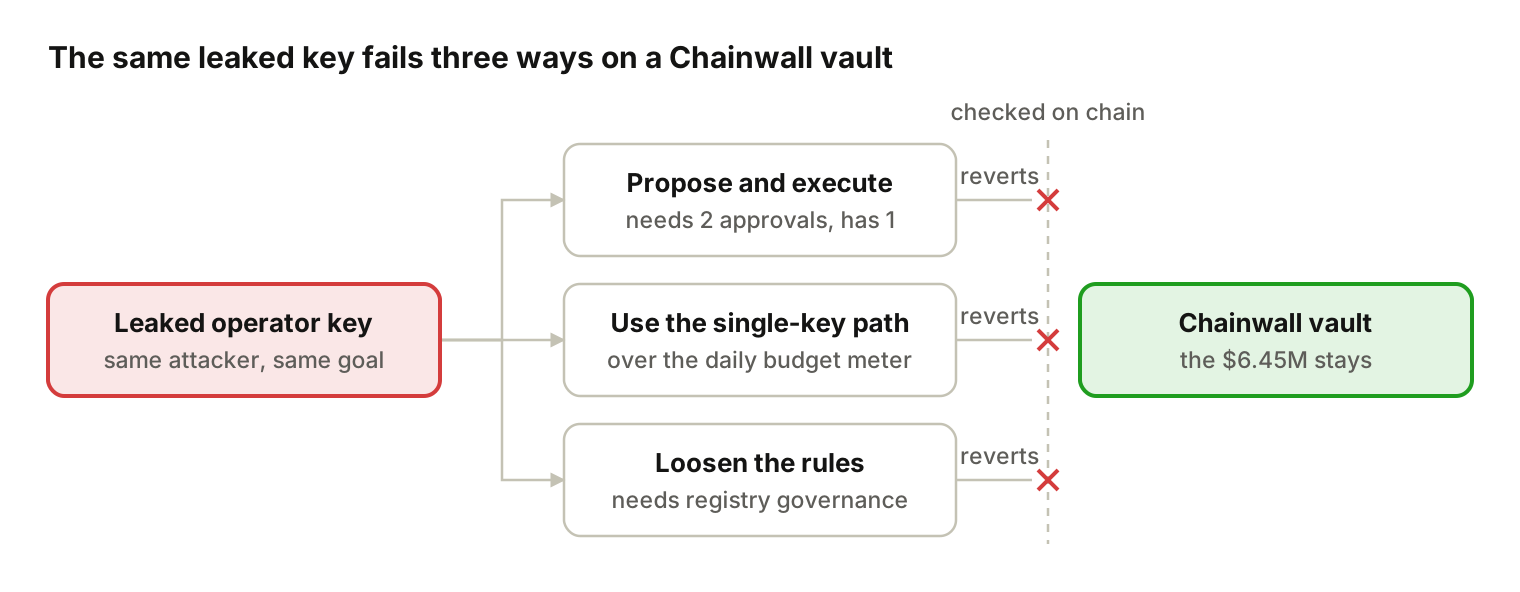
Attack replay on a Chainwall vault. Example policy: 2 approvals, daily budget meter
The operator key can't change the rules either. Policies and group membership are changed through registry governance. The Safe itself sits behind OKGuard, which only lets it call Chainwall's Interact contract or delegatecall the singleton migrator, and which blocks Safe self-calls. Enabling a module is a self-call, so nobody can attach a second executor to the vault later.
Scripts can also only call contracts that resolve from the registry, and the operation's hash covers the interaction, its arguments, its dependencies and the policy. By default, if any of that differs at execution, the operation is refused.
The threshold is a field on the policy and the meter comes from a template. The CLI repo also includes a chainwall-operations agent skill, so you can have your coding agent deploy the vault and register both.
If you run a Roles setup today
You can lower your risk without migrating anything. Open your Roles configuration and work out, for each role member, the largest amount that key could move on its own. If that number is more than you'd keep in a hot wallet, narrow the policy. For every function a role can call, check each address parameter and not only the recipient. Here the beneficiary was pinned to the Safe while the executor was left open. Look hardest at roles that were set up a long time ago, because the key used here had held its role since June 2024.
Chainwall enforces thresholds and spending caps on delegated keys as onchain rules.