
Events
- Ethereum
- Ethereum Blockchain
- Ethdenver 2025
- Ethdenver
- AI Agent
Wrapping Up ETHDenver 2025
What ETHDenver 2025 revealed about transactional AI agents, cross-chain liquidity, and the security infrastructure needed for both.
This year, at ETHDenver 2025, AI agents took center stage, with many attendees referring to the event as “AIDenver.” The focus on agentic AI, decentralized AI, and privacy-preserving AI marked a clear shift from past years, showing a broader acceptance of AI-driven tools in the crypto space.
We hosted {ok} builders day meetup during ETHDenver to bring together remarkable builders in the industry and spotlight two topics we at OKcontract are exploring in 2025: Evolution of transactional AI agents and solutions for cross-chain liquidity fragmentation.
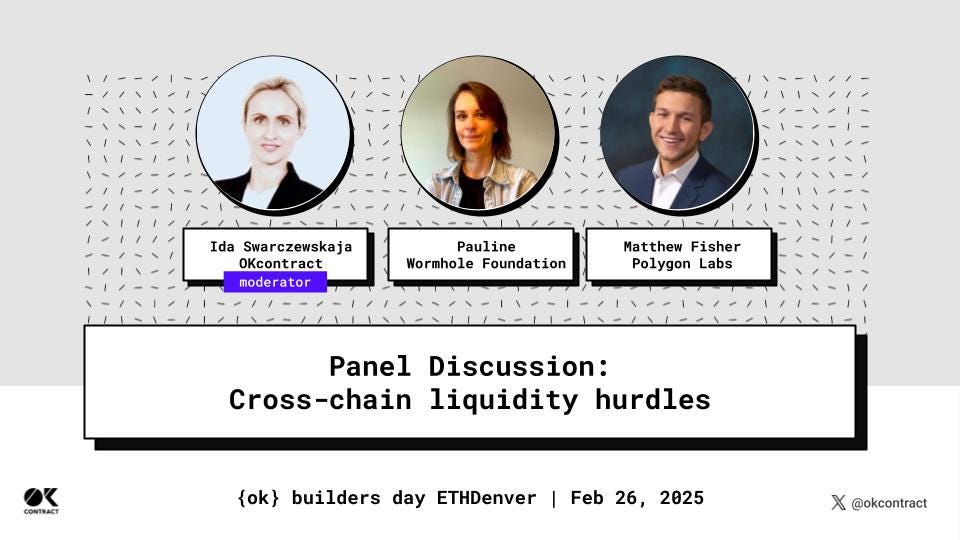
Cross-chain liquidity hurdles
To explore cross-chain liquidity hurdles, our co-founder, Ida invited Matthew, a DeFi specialist at Polygon Labs, and Pauline, DevRel at Wormhole Foundation. The conversation looked at the adoption and challenges of bridging solutions, plus how AggLayer and Wormhole tackle these issues. The panel also discussed choosing multi-chain vs cross-chain dApps from a developer viewpoint, along with the building efforts and costs. Another key focus was the importance of behind-the-scenes bridging so that users can move smoothly between environments while seeking better yields. The panel covered workflows to address liquidity fragmentation — including message passing, consistent UX, and aggregated balances across chains — and pointed to how this fragmentation might be resolved over time.
Panel recording is available here.
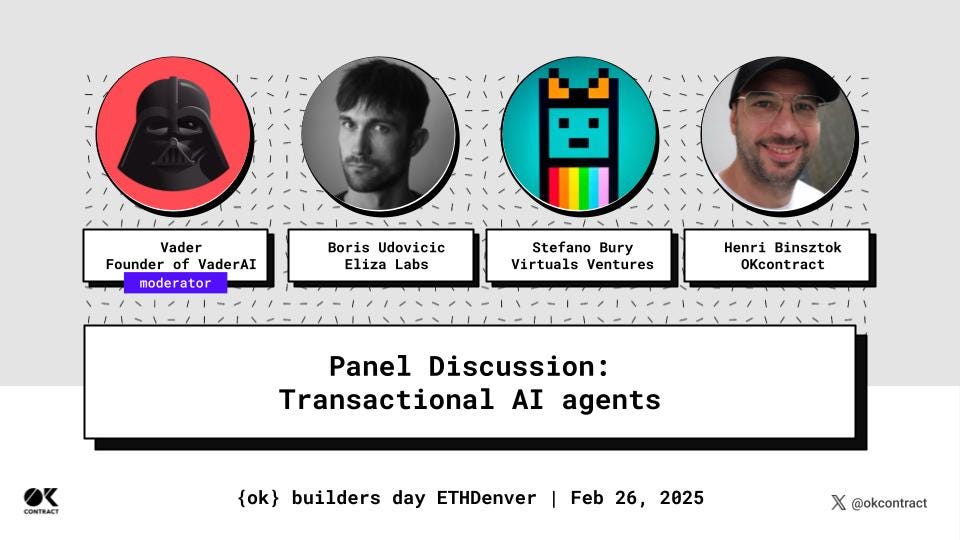
Transactional AI agents
Our second panel, titled “Transactional AI Agents,” explored the potential of AI agents to manage financial operations and execute onchain transactions. Moderated by Vader, the founder of VaderAI, the panelists included Boris, PM at ElizaOS, Bury, lead at Virtuals Ventures, ecosystem fund for agents launching on Virtuals, and Henri, OKcontract co-founder working on connections with agentic platforms. The panelists discussed the main use cases that are currently addressed by AI agents and looked in the the future use cases, the opportunities of multi-agent systems, and how agents can collaborate with other systems. The panel also addressed how agents can perform tasks on behalf of users and manage wallets, how trading or purchasing agents can execute transactions, and the risks of giving agents control of user wallets. They discussed the pitfalls LLM-based systems can face and how safe middleware can help mitigate them.
Panel recording is available here.
Why it matters
Cross-chain liquidity fragmentation limits broader crypto adoption, complicates user choices, and makes yield opportunities harder to access. Automated bridging behind the scenes could make life easier for users and for developers who prefer fewer hassles while building and maintaining integrations across multiple chains. Meanwhile, transactional AI agents hold promise for automating tasks like payments, investments, trading, treasury management, or any type of onchain interactions. Yet once agents transact on the blockchain, errors or exploits can be costly, which is why secure middleware is vital. By smoothing cross-chain liquidity flows and providing safe, reusable infrastructure for transacting AI agents, the crypto space will gain stronger user confidence and broader participation.
Originally published on Medium.